6d96accd63
* Feat(tuic): Implement native TUIC v5 protocol support via Rust sidecar daemon

- Add internal/tuic package for official tuic-server sidecar lifecycle management, configuration generation, and graceful process control
- Bridge decrypted TUIC QUIC traffic into loopback Xray SOCKS5 inbounds (63200+id) for traffic accounting, statistics, and routing rules
- Implement periodic reconciliation job (cadence @every 10s) and immediate runtime synchronization on inbound/client mutations
- Add TUIC inbound & multi-user client settings (UUID + Password authentication) in Web UI with SNI auto-fill and panel certificate loader
- Integrate tuic:// subscription links and Clash.Meta (Mihomo) proxy generation for TUIC
- Update install.sh to automatically download and install official tuic-server release for x86_64, aarch64, and armv7
- Add full localization for TUIC protocol across all 13 supported languages

* Feat(install): Support custom repository and branch in install and update scripts

* Ci(release): Enable publish-dev for feature branch and workflow dispatch

* Feat(sub): Add TUIC to subscription resolution and client QR config generator

- Add 'tuic' to getInboundsBySubId SQL allowlist to resolve TUIC inbounds in subscriptions and sub links
- Enhance buildTuicProxy in Clash subscription generator with robust host and credentials resolution
- Add tuicConfig.ts to generate standalone Clash/Mihomo YAML configuration
- Add dedicated TUIC Config tab in ClientQrModal with QR code and .yaml download button
- Add localization keys for TUIC config across all 13 supported languages

* Fix(tuic): Exclude TUIC from native Xray inbounds and strip udp_relay_mode from server config

- Exclude model.TUIC from native Xray inbounds in GetXrayConfig to prevent Xray startup failure
- Remove udp_relay_mode from tuic-server JSON configuration builder
- Update install.sh to install tuic-server binary to both xui_folder/bin and /usr/local/bin

* Fix(install): Fallback to dev-latest when releases/latest is not present on fork

* Feat(tuic): Add real-time online status and LastOnline tracking for TUIC clients

- Track client activity by mapping client UUID in tuic-server logs to email
- Integrate TUIC active clients into XrayTrafficJob to refresh local online clients
- Bump LastOnline timestamp in database and broadcast live online status over WebSocket

* Feat(tuic): Implement real-time traffic statistics and live speed reporting for TUIC

- Collect precise I/O traffic deltas for tuic-server child processes via /proc/<pid>/io
- Aggregate and attribute TUIC traffic deltas per client in tuic Manager
- Integrate TUIC traffic deltas into XrayTrafficJob to update database and broadcast live speed

* Feat(tuic): Finalize TUIC v5 integration with 1:1 traffic counting and orphan process cleanup
- Use exact 1:1 byte delta accounting from /proc/<pid>/io
- Add killStrayTuicProcesses to terminate orphan sidecars on panel startup
- Fully integrate TUIC with subscriptions, live speed meter, and all 13 locales

* Feat(frontend): Polish TUIC UI, support bulk operations, and update translations

- Align TUIC inbound certificate form with standard 3X-UI layout (Set Default Cert, Clear)
- Remove extra subtitle hint text from TUIC inbound form fields
- Support TUIC in client bulk attach/detach and bulk add modals
- Add TUIC badge color to client info modal, clients table, and host list
- Update password tooltip across all 13 locales to include TUIC
- Remove obsolete dead translation keys across all 13 locales

* Chore(ci): Finalize TUIC v5 bundling across release workflow, Docker, and scripts

* Feat(openapi): Update OpenAPI generator and schemas for TUIC types

* Fix(backend): Address core review findings for TUIC types, port checks, and xray bridge

* Refactor(traffic): Isolate proc reading with build tags and decouple TUIC metering into TuicJob

* Feat(client): Add TuicServer to InboundOption, fix config export and clean share links

* Fix(frontend): Register TUIC in multi-user helpers, tracked protocols, and tag derivation

* Chore(openapi): Re-generate OpenAPI specification and sync Zod schemas

* Chore(scripts): Add Alpine musl binaries, 386 and Windows packaging, and anchor pkill

* Fix(review): Remove stale import, correct binary names, switch to musl, and drop unreachable relay gate

* Feat(frontend): Show share link in Inbound Info and display UDP tag for TUIC

* Docs: Add TUIC v5 configuration guide and link specifications

* Docs(tuic): Correct Clash Meta configuration parameter to reduce-rtt

* Fix(tuic): Generate client credentials on copy, enforce ID/password validation, and add i386 to DockerInit

* Fix(tuic): drop unused relay, fix traffic accounting, and honor host endpoints

- Drop unused loopback SOCKS relay and eliminate port collision with AmneziaWG
- Correct inbound traffic calculation without double-counting
- Drop heuristic client traffic division while retaining online tracking
- Support externalProxy host fan-out and conditional parameters in share links
- Scope orphan process termination to managed config directory

* Fix(tuic): enforce client quotas, decouple Xray restart, and sync openapi schemas

- Regenerate OpenAPI, Zod schemas, and TypeScript types without route_through_xray
- Populate clientTraffics in TuicJob to enforce client quotas and first-use expiry
- Split process I/O delta into up and down in Process.CollectTraffic
- Remove SetNeedRestart from updateTuicInbound to prevent Xray session drops
- Use InstanceFromInbound for default ALPN and UDP relay mode in tuic:// share links
- Support allow_insecure on externalProxy host endpoints without parameter collision

* Fix(tuic): attribute client traffic only on single-user inbounds and sync link defaults

- Attribute I/O deltas to the client only when the inbound has exactly one configured client, avoiding false billing and disablings on multi-user inbounds
- Aggregate client traffic by email in TuicJob so clients on multiple inbounds don't lose deltas
- Match frontend genTuicLink defaults for alpn and udp_relay_mode with backend subscription links

* Fix(tuic): gate client traffic by total sidecar clients and require client email

* Fix(tuic): enforce inbound-only traffic limits and disable client totalGB

* fix(tuic): restore delayed start, remove client totalGB rejection, and document linux-only limits

* fix(tuic): anchor pkill, fix io baseline/split, escape yaml, and deduplicate start errors

* fix(tuic): prevent traffic double-counting, ensure info log level for delayed start, and broaden pkill matching

* fix(tuic): address review round 11 findings

- internal/sub/json_service: skip tuic protocol in json subscription to prevent direct routing leak
- internal/sub/clash_service: honor externalProxy/host row allowInsecure, sni, and alpn in buildTuicProxy
- internal/web/runtime: decouple tuic inbound add/delete from xray restart
- internal/tuic/config: restore user log-level options (warn, error) without forced info clamp
- frontend/src/lib/xray/inbound-link: fix duplicate remark suffix and apply externalProxy TLS overrides
- frontend/src/schemas/protocols/stream/external-proxy: propagate allowInsecure through host mapping
- tests: add coverage for json sub skip, clash proxy overrides, and link generation

* fix(tuic): meter inbound traffic through a UDP relay and bracket IPv6 binds

Review repairs on the TUIC v5 sidecar integration:

- Inbound traffic was read from the sidecar's /proc/<pid>/io rchar, but
  the kernel only counts read()/write() there and tuic-server moves its
  sockets with recvfrom/recvmmsg/sendmmsg/sendto, so an inbound's up/down
  stayed at 0 forever and inbound total limits never tripped (measured:
  12 MiB relayed, rchar delta 0). The panel now owns the inbound's public
  UDP port with a small relay and runs tuic-server behind it on a loopback
  port, counting up/down exactly on every OS. tuic-server therefore logs
  127.0.0.1 as every client's address; per-client attribution stays
  unsupported since QUIC is opaque.
- Instance.BindTo formatted an IPv6 listen address as ":::8443", which
  tuic-server rejects with "invalid socket address syntax", so an inbound
  listening on "::" or any IPv6 literal never started. It now uses
  net.JoinHostPort; IPv4 output is unchanged.
- The log level is passed to the sidecar as chosen. Online status,
  last-online and delayed start are read from its Info lines, so the Log
  Level field now says that Warn and Error switch them off for the
  inbound, and the docs say the same.
- Drop two frontend tests that only exercised a getter and a set lookup,
  and strip the trailing blank line that made gofumpt fail on two of the
  new Go test files.

* fix(tuic): harden tag updates, runtime routing, and relay stability

---------

Co-authored-by: poise52 <equipoise52@gmail.com>
Co-authored-by: Sanaei <ho3ein.sanaei@gmail.com>
English | فارسی | العربية | 中文 | Español | Русский | Türkçe






3X-UI is an advanced, open-source web control panel for managing Xray-core servers. It provides a clean, multi-language interface for deploying, configuring, and monitoring a wide range of proxy and VPN protocols — from a single VPS to multi-node deployments.
Built as an enhanced fork of the original X-UI project, 3X-UI adds broader protocol support, improved stability, per-client traffic accounting, and many quality-of-life features.
Important
This project is intended for personal use only. Please do not use it for illegal purposes or in a production environment.
Features
- Multi-protocol inbounds — VLESS, VMess, Trojan, Shadowsocks, WireGuard, AmneziaWG, Hysteria2, MTProto, HTTP, SOCKS (Mixed), Dokodemo-door / Tunnel, and TUN.
- Modern transports & security — TCP (Raw), mKCP, WebSocket, gRPC, HTTPUpgrade, and XHTTP, secured with TLS, XTLS, and REALITY.
- AmneziaWG built in — DPI-resistant WireGuard runs inside the panel on a userspace network stack, with no kernel module, DKMS, or extra packages to install.
- MTProto proxies — per-client FakeTLS secrets, ad-tags, and quotas, applied live without dropping existing connections.
- Fallbacks — serve multiple protocols on a single port (e.g. VLESS and Trojan on 443) using Xray's fallback support.
- Per-client management — traffic quotas, expiry dates, IP limits with trusted-address exemptions, HWID device limits, scheduled renewal cycles, live online status, and one-click share links, QR codes, and subscriptions.
- Traffic statistics — per inbound, per client, and per outbound, with reset controls.
- Multi-node support — manage and scale across multiple servers from a single panel, including cloning inbounds onto other nodes.
- Outbound & routing — WARP, NordVPN, PIA, custom routing rules, load balancers with balancer-to-balancer fallback, and outbound proxy chaining. Bundled geosite and geoip categories are browsable straight from the rule editor.
- Built-in subscription server — raw, JSON, and Clash output, auto-selected from the client's User-Agent, plus custom page templates.
- Telegram bot for remote monitoring and management.
- RESTful API with scoped, optionally expiring tokens and an in-panel API reference.
- Installable panel (PWA) — pin 3X-UI to a desktop or phone home screen.
- Flexible storage — SQLite (default) or PostgreSQL.
- 13 UI languages with dark and light themes.
- Fail2ban integration for enforcing per-client IP limits.
Screenshots
Click to expand


Quick Start
bash <(curl -Ls https://raw.githubusercontent.com/mhsanaei/3x-ui/master/install.sh)
To install a specific version, append its tag (e.g. v3.7.0):
bash <(curl -Ls https://raw.githubusercontent.com/mhsanaei/3x-ui/master/install.sh) v3.7.0
To install the rolling dev build (latest per-commit pre-release from main, not a stable release), pass dev-latest:
bash <(curl -Ls https://raw.githubusercontent.com/mhsanaei/3x-ui/master/install.sh) dev-latest
During installation a random username, password, and access path are generated. After installation, run x-ui to open the management menu, where you can start/stop the service, view or reset your login credentials, manage SSL certificates, and more.
Every release asset is published with a .sha256 sum next to it. Both install.sh and the updater verify the archive against that sum and abort on a mismatch.
For full documentation — installation, configuration, operations, and the complete API reference — visit docs.sanaei.dev.
Unattended install
The installer also runs non-interactively for cloud-init.
Set XUI_NONINTERACTIVE=1 (or pipe with no TTY) and it installs end-to-end with
zero prompts, generating random credentials and writing them to
/etc/x-ui/install-result.env. See deploy/ for:
- Cloud-init user-data — unattended install on any cloud (Hetzner/AWS/DO/Vultr/GCP/Azure/Oracle)
- Hetzner Cloud notes — cloud-init deployment on Hetzner
Supported Platforms
Operating systems: Ubuntu, Debian, Armbian, Fedora, CentOS, RHEL, AlmaLinux, Rocky Linux, Oracle Linux, Amazon Linux, Virtuozzo, Arch, Manjaro, Parch, openSUSE (Tumbleweed / Leap), Alpine, and Windows.
Architectures: amd64 · 386 · arm64 (aarch64) · armv7 · armv6 · armv5 · s390x.
Database Options
3X-UI supports two backends, chosen during the install:
- SQLite (default) — a single file at
/etc/x-ui/x-ui.db. Zero setup, ideal for small and medium deployments. - PostgreSQL — recommended for high client counts or multi-node setups. The installer can install PostgreSQL locally for you, or accept a DSN to an existing server.
At runtime the backend is selected via environment variables (the installer writes these to /etc/default/x-ui for you):
XUI_DB_TYPE=postgres
XUI_DB_DSN=postgres://xui:password@127.0.0.1:5432/xui?sslmode=disable
Migrating an existing SQLite install to PostgreSQL
x-ui migrate-db --dsn "postgres://xui:password@127.0.0.1:5432/xui?sslmode=disable"
# then set XUI_DB_TYPE and XUI_DB_DSN in /etc/default/x-ui and restart:
systemctl restart x-ui
The source SQLite file is left untouched; remove it manually once you have verified the new backend.
Docker
The default docker compose up -d keeps using SQLite. To run with the bundled PostgreSQL service, uncomment the two XUI_DB_* env lines in docker-compose.yml and start with the profile:
docker compose --profile postgres up -d
The image bundles Fail2ban (enabled by default) to enforce per-client IP limits. Fail2ban bans offenders with iptables, which requires the NET_ADMIN capability. docker-compose.yml already grants it via cap_add; if you start the container with docker run instead, add the capabilities yourself, otherwise bans are logged but never applied:
docker run -d --cap-add=NET_ADMIN --cap-add=NET_RAW ... ghcr.io/mhsanaei/3x-ui
Environment Variables
| Variable | Description | Default |
|---|---|---|
XUI_DB_TYPE |
Database backend: sqlite or postgres |
sqlite |
XUI_DB_DSN |
PostgreSQL connection string (when XUI_DB_TYPE=postgres) |
— |
XUI_DB_FOLDER |
Directory for the SQLite database file | /etc/x-ui |
XUI_DB_MAX_OPEN_CONNS |
Maximum open connections (PostgreSQL pool) | — |
XUI_DB_MAX_IDLE_CONNS |
Maximum idle connections (PostgreSQL pool) | — |
XUI_INIT_WEB_BASE_PATH |
The initial URI path for the web panel | / |
XUI_ENABLE_FAIL2BAN |
Enable Fail2ban-based IP-limit enforcement | true |
XUI_LOG_LEVEL |
Log verbosity (debug, info, warning, error) |
info |
XUI_DEBUG |
Enable debug mode | false |
XUI_TUNNEL_HEALTH_MONITOR |
Enable the tunnel health monitor (probes a URL and restarts xray after repeated failures; a restart drops all clients) | false |
XUI_TUNNEL_HEALTH_PROXY |
Proxy the probe is sent through; point it at a local xray inbound so the probe tests the tunnel (e.g. socks5://127.0.0.1:1080). Empty means the probe only checks host connectivity |
— |
XUI_TUNNEL_HEALTH_URL |
URL probed for tunnel health | https://www.cloudflare.com/cdn-cgi/trace |
XUI_TUNNEL_HEALTH_INTERVAL |
Interval between probes | 30s |
XUI_TUNNEL_HEALTH_TIMEOUT |
Per-probe timeout | 10s |
XUI_TUNNEL_HEALTH_FAILURES |
Consecutive failures before a restart is triggered | 3 |
XUI_TUNNEL_HEALTH_COOLDOWN |
Minimum delay between consecutive restarts | 5m |
NODE_TOKEN_ENCRYPTION |
Encryption at rest for node API tokens: off, migration, or required (note: no XUI_ prefix) |
off |
XUI_NODE_TOKEN_KEY_FILE |
JSON keyring (mode 0600) holding the active key id and its base64 32-byte keys |
/etc/x-ui/node_token_key.json |
XUI_NODE_TOKEN_KEY |
A single base64 32-byte key, used only when the key file cannot be loaded | — |
The complete list is on the environment variables reference.
Supported Languages
The panel UI is available in 13 languages:
English · فارسی · العربية · 中文(简体) · 中文(繁體) · Español · Русский · Українська · Türkçe · Tiếng Việt · 日本語 · Bahasa Indonesia · Português (Brasil)
Contributing
Contributions are welcome. Please read the Contributing Guide before opening an issue or pull request.
A Special Thanks to
Acknowledgment
- Iran v2ray rules (License: GPL-3.0): Enhanced v2ray/xray and v2ray/xray-clients routing rules with built-in Iranian domains and a focus on security and adblocking.
- Russia v2ray rules (License: GPL-3.0): This repository contains automatically updated V2Ray routing rules based on data on blocked domains and addresses in Russia.
Community Tools
Tools and integrations built by the community around 3x-ui.
- terraform-provider-3x-ui (License: MIT): Manage inbounds, clients, panel settings, and Xray configuration as code with Terraform / OpenTofu.
Support project
If this project is helpful to you, you may wish to give it a🌟


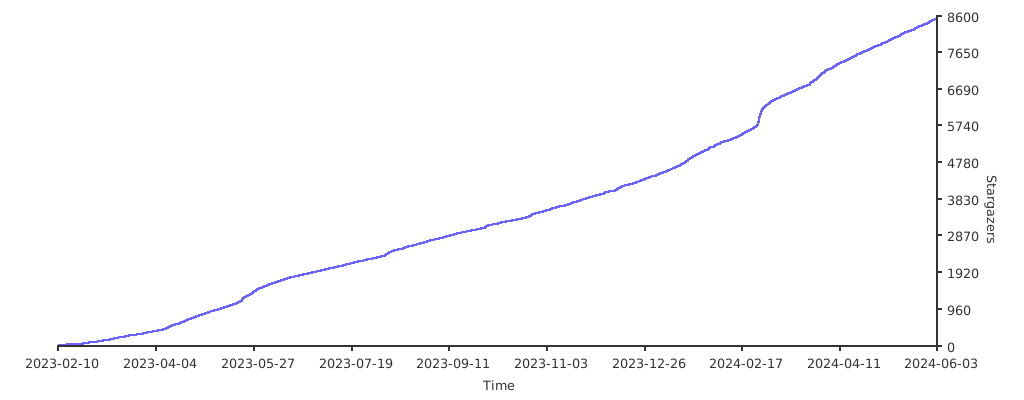
Stargazers over Time