8f162994ef
* feat(clients): let admins set PersistentKeepalive on tunnel clients

model.Client already carries KeepAlive, and every AmneziaWG/WireGuard client
config emitter already writes PersistentKeepalive when it is above zero -- but
nothing in the UI could set it, so it stayed 0 and the line was never emitted.

Without it a peer that goes quiet has nothing to trigger a handshake: WireGuard
only initiates when it has data to send. An idle client stays disconnected
after any interruption -- a NAT mapping timing out, a device sleeping, the
panel restarting -- until the user generates traffic themselves.

New clients default to 25, the conventional value, which also keeps the NAT
mapping open. Existing clients keep whatever they have, and 0 remains valid and
means "do not send keepalives".

* fix(clients): let an explicit 0 actually disable PersistentKeepalive

Addresses review feedback on the previous commit.

UpdateInboundClient carries a stored keepalive forward whenever the incoming
one is zero, so the settings JSON and the running peer survive a metadata-only
edit that omits the field. That was a 0 -> 0 no-op while no UI could set a
nonzero value. Now that the client form can, the carry-forward became reachable
in the other direction: a client created at the form's default of 25 could
never be returned to 0, and the hint text shipped to all 13 locales -- "0
disables it" -- described something the backend silently refused. The save even
reported success, because a settings blob that came back byte-identical skips
the transaction entirely.

The zero value cannot carry that distinction, so model.Client.KeepAlive becomes
*int: nil means the field was never sent, &0 means "send no keepalives". The
pointer survives the internal marshal in ClientService.Update, which is where an
explicit 0 was being erased by omitempty before UpdateInboundClient ever saw it.
ClientRecord.KeepAlive stays a plain int -- it is the stored column, where
"unset" has no meaning -- and the conversions bridge the two.

Two tests, both red before this change in the direction they cover: an explicit
0 must reach wg_keep_alive, and an update that omits the field must still leave
a stored 25 alone.

Also adds the output transform every other numeric field in the client form
already has, so a cleared box sends 0 rather than null.

* fix(clients): repair the keepalive pointer conversion after the main merge

Merging main brought buildAmneziaWGProxy (#6326) in beside the
Client.KeepAlive int -> *int change without reconciling the new call site,
so internal/sub stopped compiling and took every package importing it with
it. The two sides touched different lines, so git merged them without a
conflict -- the green `make verify` on 112b19a8 predates the break.

ToClient also wrapped a stored 0 in a pointer, so omitempty stopped
omitting: a VLESS client's settings JSON gained "keepAlive": 0 on the
attach and bulk-attach paths, and that JSON reaches xray-core verbatim
through GenXrayInboundConfig. wg_keep_alive cannot tell "off" from "never
set", so a stored 0 now stays nil.

Also copies the regenerated openapi.json over the docs mirror, which
nothing in CI checks, and trims two comment blocks to the two-line cap.

---------

Co-authored-by: Sanaei <ho3ein.sanaei@gmail.com>
English | فارسی | العربية | 中文 | Español | Русский | Türkçe






3X-UI is an advanced, open-source web control panel for managing Xray-core servers. It provides a clean, multi-language interface for deploying, configuring, and monitoring a wide range of proxy and VPN protocols — from a single VPS to multi-node deployments.
Built as an enhanced fork of the original X-UI project, 3X-UI adds broader protocol support, improved stability, per-client traffic accounting, and many quality-of-life features.
Important
This project is intended for personal use only. Please do not use it for illegal purposes or in a production environment.
Features
- Multi-protocol inbounds — VLESS, VMess, Trojan, Shadowsocks, WireGuard, AmneziaWG, Hysteria2, MTProto, HTTP, SOCKS (Mixed), Dokodemo-door / Tunnel, and TUN.
- Modern transports & security — TCP (Raw), mKCP, WebSocket, gRPC, HTTPUpgrade, and XHTTP, secured with TLS, XTLS, and REALITY.
- AmneziaWG built in — DPI-resistant WireGuard runs inside the panel on a userspace network stack, with no kernel module, DKMS, or extra packages to install.
- MTProto proxies — per-client FakeTLS secrets, ad-tags, and quotas, applied live without dropping existing connections.
- Fallbacks — serve multiple protocols on a single port (e.g. VLESS and Trojan on 443) using Xray's fallback support.
- Per-client management — traffic quotas, expiry dates, IP limits with trusted-address exemptions, HWID device limits, scheduled renewal cycles, live online status, and one-click share links, QR codes, and subscriptions.
- Traffic statistics — per inbound, per client, and per outbound, with reset controls.
- Multi-node support — manage and scale across multiple servers from a single panel, including cloning inbounds onto other nodes.
- Outbound & routing — WARP, NordVPN, PIA, custom routing rules, load balancers with balancer-to-balancer fallback, and outbound proxy chaining. Bundled geosite and geoip categories are browsable straight from the rule editor.
- Built-in subscription server — raw, JSON, and Clash output, auto-selected from the client's User-Agent, plus custom page templates.
- Telegram bot for remote monitoring and management.
- RESTful API with scoped, optionally expiring tokens and an in-panel API reference.
- Installable panel (PWA) — pin 3X-UI to a desktop or phone home screen.
- Flexible storage — SQLite (default) or PostgreSQL.
- 13 UI languages with dark and light themes.
- Fail2ban integration for enforcing per-client IP limits.
Screenshots
Click to expand


Quick Start
bash <(curl -Ls https://raw.githubusercontent.com/mhsanaei/3x-ui/master/install.sh)
To install a specific version, append its tag (e.g. v3.7.0):
bash <(curl -Ls https://raw.githubusercontent.com/mhsanaei/3x-ui/master/install.sh) v3.7.0
To install the rolling dev build (latest per-commit pre-release from main, not a stable release), pass dev-latest:
bash <(curl -Ls https://raw.githubusercontent.com/mhsanaei/3x-ui/master/install.sh) dev-latest
During installation a random username, password, and access path are generated. After installation, run x-ui to open the management menu, where you can start/stop the service, view or reset your login credentials, manage SSL certificates, and more.
Every release asset is published with a .sha256 sum next to it. Both install.sh and the updater verify the archive against that sum and abort on a mismatch.
For full documentation — installation, configuration, operations, and the complete API reference — visit docs.sanaei.dev.
Unattended install
The installer also runs non-interactively for cloud-init.
Set XUI_NONINTERACTIVE=1 (or pipe with no TTY) and it installs end-to-end with
zero prompts, generating random credentials and writing them to
/etc/x-ui/install-result.env. See deploy/ for:
- Cloud-init user-data — unattended install on any cloud (Hetzner/AWS/DO/Vultr/GCP/Azure/Oracle)
- Hetzner Cloud notes — cloud-init deployment on Hetzner
Supported Platforms
Operating systems: Ubuntu, Debian, Armbian, Fedora, CentOS, RHEL, AlmaLinux, Rocky Linux, Oracle Linux, Amazon Linux, Virtuozzo, Arch, Manjaro, Parch, openSUSE (Tumbleweed / Leap), Alpine, and Windows.
Architectures: amd64 · 386 · arm64 (aarch64) · armv7 · armv6 · armv5 · s390x.
Database Options
3X-UI supports two backends, chosen during the install:
- SQLite (default) — a single file at
/etc/x-ui/x-ui.db. Zero setup, ideal for small and medium deployments. - PostgreSQL — recommended for high client counts or multi-node setups. The installer can install PostgreSQL locally for you, or accept a DSN to an existing server.
At runtime the backend is selected via environment variables (the installer writes these to /etc/default/x-ui for you):
XUI_DB_TYPE=postgres
XUI_DB_DSN=postgres://xui:password@127.0.0.1:5432/xui?sslmode=disable
Migrating an existing SQLite install to PostgreSQL
x-ui migrate-db --dsn "postgres://xui:password@127.0.0.1:5432/xui?sslmode=disable"
# then set XUI_DB_TYPE and XUI_DB_DSN in /etc/default/x-ui and restart:
systemctl restart x-ui
The source SQLite file is left untouched; remove it manually once you have verified the new backend.
Docker
The default docker compose up -d keeps using SQLite. To run with the bundled PostgreSQL service, uncomment the two XUI_DB_* env lines in docker-compose.yml and start with the profile:
docker compose --profile postgres up -d
The image bundles Fail2ban (enabled by default) to enforce per-client IP limits. Fail2ban bans offenders with iptables, which requires the NET_ADMIN capability. docker-compose.yml already grants it via cap_add; if you start the container with docker run instead, add the capabilities yourself, otherwise bans are logged but never applied:
docker run -d --cap-add=NET_ADMIN --cap-add=NET_RAW ... ghcr.io/mhsanaei/3x-ui
Environment Variables
| Variable | Description | Default |
|---|---|---|
XUI_DB_TYPE |
Database backend: sqlite or postgres |
sqlite |
XUI_DB_DSN |
PostgreSQL connection string (when XUI_DB_TYPE=postgres) |
— |
XUI_DB_FOLDER |
Directory for the SQLite database file | /etc/x-ui |
XUI_DB_MAX_OPEN_CONNS |
Maximum open connections (PostgreSQL pool) | — |
XUI_DB_MAX_IDLE_CONNS |
Maximum idle connections (PostgreSQL pool) | — |
XUI_INIT_WEB_BASE_PATH |
The initial URI path for the web panel | / |
XUI_ENABLE_FAIL2BAN |
Enable Fail2ban-based IP-limit enforcement | true |
XUI_LOG_LEVEL |
Log verbosity (debug, info, warning, error) |
info |
XUI_DEBUG |
Enable debug mode | false |
XUI_TUNNEL_HEALTH_MONITOR |
Enable the tunnel health monitor (probes a URL and restarts xray after repeated failures; a restart drops all clients) | false |
XUI_TUNNEL_HEALTH_PROXY |
Proxy the probe is sent through; point it at a local xray inbound so the probe tests the tunnel (e.g. socks5://127.0.0.1:1080). Empty means the probe only checks host connectivity |
— |
XUI_TUNNEL_HEALTH_URL |
URL probed for tunnel health | https://www.cloudflare.com/cdn-cgi/trace |
XUI_TUNNEL_HEALTH_INTERVAL |
Interval between probes | 30s |
XUI_TUNNEL_HEALTH_TIMEOUT |
Per-probe timeout | 10s |
XUI_TUNNEL_HEALTH_FAILURES |
Consecutive failures before a restart is triggered | 3 |
XUI_TUNNEL_HEALTH_COOLDOWN |
Minimum delay between consecutive restarts | 5m |
NODE_TOKEN_ENCRYPTION |
Encryption at rest for node API tokens: off, migration, or required (note: no XUI_ prefix) |
off |
XUI_NODE_TOKEN_KEY_FILE |
JSON keyring (mode 0600) holding the active key id and its base64 32-byte keys |
/etc/x-ui/node_token_key.json |
XUI_NODE_TOKEN_KEY |
A single base64 32-byte key, used only when the key file cannot be loaded | — |
The complete list is on the environment variables reference.
Supported Languages
The panel UI is available in 13 languages:
English · فارسی · العربية · 中文(简体) · 中文(繁體) · Español · Русский · Українська · Türkçe · Tiếng Việt · 日本語 · Bahasa Indonesia · Português (Brasil)
Contributing
Contributions are welcome. Please read the Contributing Guide before opening an issue or pull request.
A Special Thanks to
Acknowledgment
- Iran v2ray rules (License: GPL-3.0): Enhanced v2ray/xray and v2ray/xray-clients routing rules with built-in Iranian domains and a focus on security and adblocking.
- Russia v2ray rules (License: GPL-3.0): This repository contains automatically updated V2Ray routing rules based on data on blocked domains and addresses in Russia.
Community Tools
Tools and integrations built by the community around 3x-ui.
- terraform-provider-3x-ui (License: MIT): Manage inbounds, clients, panel settings, and Xray configuration as code with Terraform / OpenTofu.
Support project
If this project is helpful to you, you may wish to give it a🌟


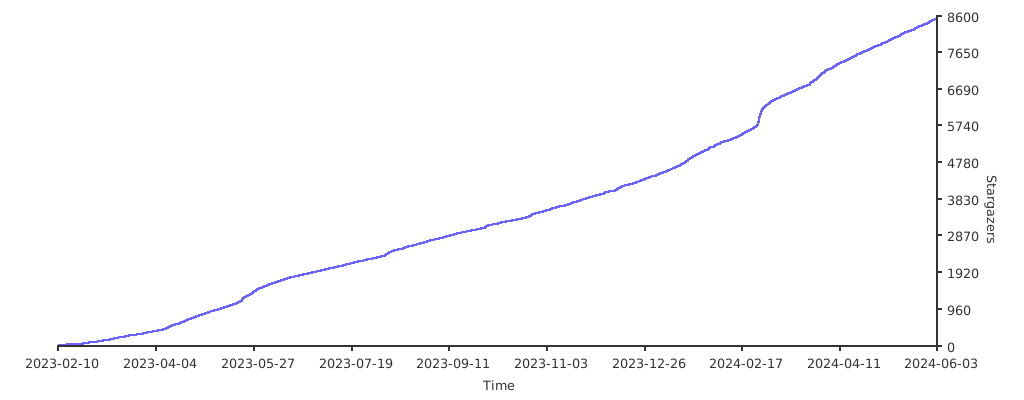
Stargazers over Time